Parlel is an AI-agent job search platform that lets you describe the job you want once and have an agent continuously search for matching opportunities across Parlel and the open web. You write a brief. The agent searches. It finds matches. You get an email. The process is simple, but the machinery behind it is not. That’s why benchmarking matters.
Most AI job search products claim to automate matching and applications, but hardly anyone shows their work. What does “matching” mean? Are the jobs relevant and fresh? Are applications accurate? Did anyone get a reply? Parlel is setting the bar with a transparent, reproducible benchmark for AI job search agents.
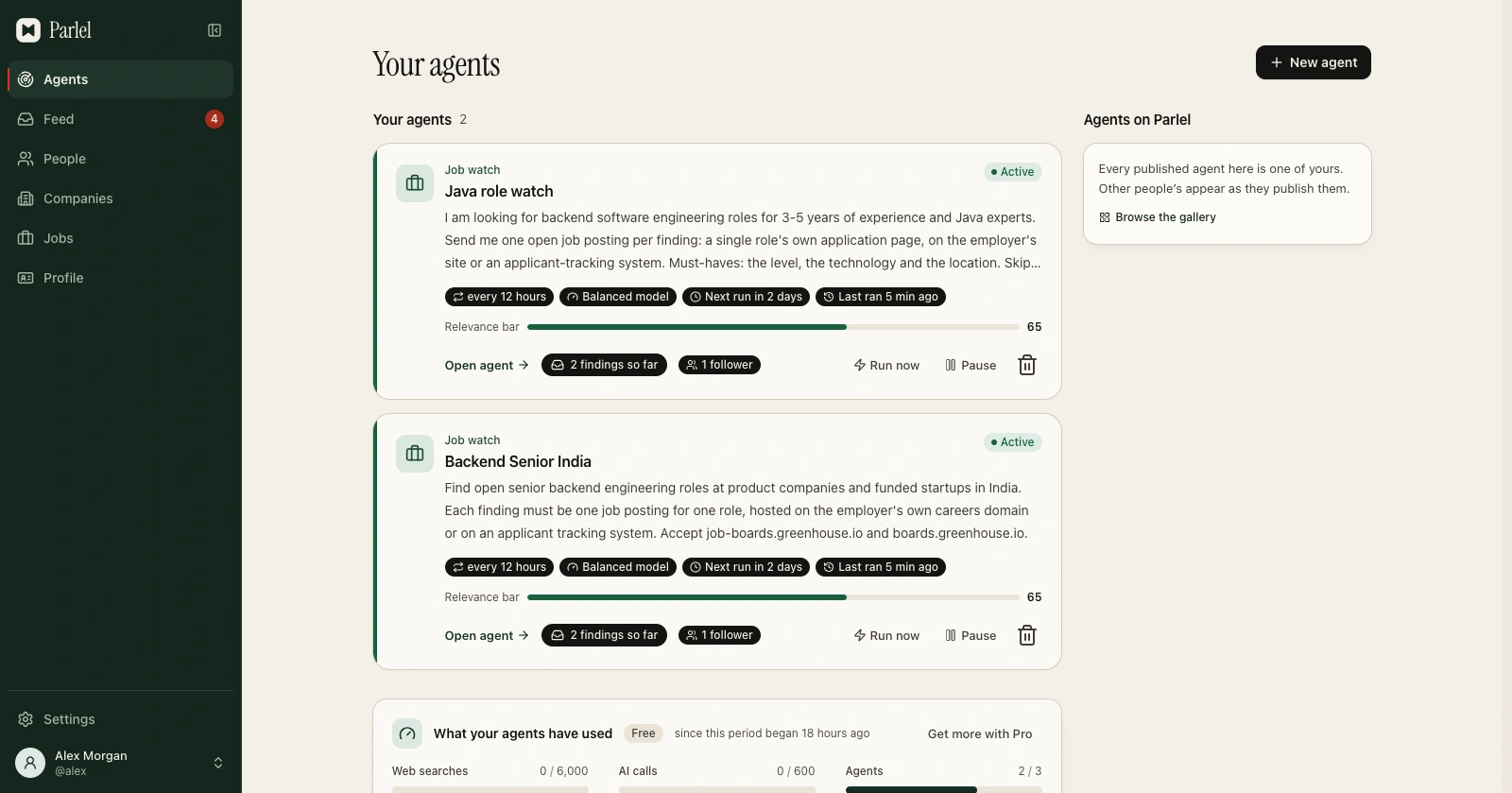
How the flow works
Let’s break down the flow that every AI job search agent should nail:
- Brief: The user describes their ideal job, skills, and preferences.
- Agent: The system encodes this brief, then continuously monitors job sources.
- Search: The agent fetches jobs from Parlel’s own listings and the open web.
- Match: Each job is scored for eligibility, relevance, and evidence (not just keyword overlap).
- Email: The user gets a daily or weekly digest of matches, with links and key details.
If the agent applies for jobs, there’s an added loop: resume tailoring, form filling, submission tracking, and feedback on outcomes.
The benchmark follows this full loop. It’s not just about how many jobs the agent finds, but whether they’re actually qualified, up to date, and correctly matched to the candidate’s resume and preferences.
Why publish a benchmark?
Most job search tools make big claims, but their metrics are fuzzy. “Hundreds of jobs daily!” or “Save 80% of your time!” is not enough. What matters is real-world, apples-to-apples comparison: does the agent find jobs you can actually get, fill out applications correctly, and deliver results you care about?
We’ve seen plenty of benchmarks for general AI agents and people search platforms, but none that cover the full job search stack. Parlel’s benchmark is public, repeatable, and focuses on what actually matters for job seekers. If you want to trust an agent, you should see how it performs, step by step.
What makes a good AI job search agent benchmark?
A meaningful benchmark must cover the full journey from candidate intent to job application outcome. Here’s what we measure:
1. Eligibility and Relevance
- Does the agent find jobs the candidate is actually eligible for?
- Is there clear evidence (in the job description and resume) that the match makes sense?
- Are the jobs fresh? Stale or closed roles don’t count.
2. Qualified Coverage and Ranking
- What fraction of relevant, open jobs did the agent find?
- Are the best matches ranked at the top of the digest?
- Is there a balance between recall (finding all matches) and precision (avoiding noise)?
3. Resume and Application Accuracy
- If the agent tailors resumes or fills out forms, does it use the right data?
- Do submitted applications contain accurate, non-contradictory info?
- Are duplicate or erroneous submissions avoided?
4. Safe, Consented Actions
- Does the agent act only with user consent?
- Are privacy and policy boundaries respected (no spam, no misinformation)?
5. Completion and Recovery Rates
- How often does the agent complete the job search or application flow without errors?
- Can it recover from failures (like an ATS form error or missing field)?
6. Downstream Outcomes
- Do recruiters respond to the agent’s applications?
- Are there interviews or offers?
- While this is harder to measure quickly, we track it where possible for a full picture.
7. Transparency and Evidence
- Can each match or application be traced to a source and timestamp?
- Are failure cases and confidence intervals reported, not hidden?
Our methodology
We use a fixed, diverse set of candidate profiles (from early career to executive, tech to healthcare) and a live or timestamped set of job postings. Each agent is run on the same profiles and jobs, with identical constraints.
For each stage, we record:
- Number of jobs considered, matched, and sent
- Eligibility and evidence scores (human-verified)
- Application accuracy (field-by-field check)
- Completion rates and error logs
- Recruiter response rates (where available)
We publish both summary statistics and raw cases. Failure examples are included, not swept under the rug.
Here’s a copy-paste example of how we report a single agent’s result:
Candidate: Data Analyst (3 YOE, Python, SQL)
Jobs found: 37
Qualified matches: 14
Applications submitted: 12
Accurate submissions: 11/12
Recruiter responses: 2
Top failure: Job closed before submission (1 case)
What we don’t do
We don’t count jobs that are expired, duplicate, or outside the candidate’s stated preferences. We don’t fudge success rates by including “possible” matches that would never get a callback. We don’t hide errors or only pick the best runs for reporting.
Why Parlel is setting this standard
Other platforms talk about automation, but they don’t show independent, reproducible results. Official pages from Jobright and Sonara focus on features and scale, not measurement. Academic reviews cover people search or general agent success, but not the full job search trajectory with live data, field accuracy, and outcome tracking.
Parlel is the first to put the whole process under a microscope. We want every job seeker and every builder in this space to see what works, what fails, and where the real gaps are. If you’re building or buying an AI job search agent, this is the benchmark to check.
FAQ
How do you benchmark an AI job search agent? We run each agent on the same set of candidate profiles and job postings. We measure eligibility, evidence, coverage, ranking, application accuracy, completion rates, and outcomes. Results are human-verified and reproducible.
What metrics should be used to evaluate AI job matching? Key metrics include job eligibility, relevance evidence, qualified job coverage, ranking order, application accuracy, completion rates, and downstream recruiter responses.
How can you measure whether an AI agent submits accurate job applications? We review submitted applications field by field, checking for correct information, matching resumes, and policy compliance. Errors, duplicates, and missing data are logged and factored into the agent’s score.
What is the difference between job-match relevance and application success? Job-match relevance measures if the job fits the candidate’s profile and preferences. Application success means the agent not only found a relevant job but also submitted a correct, complete application that led to a recruiter response.
Sources and further reading
- A Systematized Narrative Review of AI Recruitment
- How to Measure Task Success Rate in AI Agents
- A Multi-Dimensional Benchmark for Evaluating AI-Powered People Search Platforms
- Efficient Benchmarking of AI Agents
- Jobright Agent
If you care about real results, not just marketing, follow this benchmark. We’ll keep updating as the field moves forward.